Hammers

13 Unique Hammers and Their Surprisingly Specific Uses

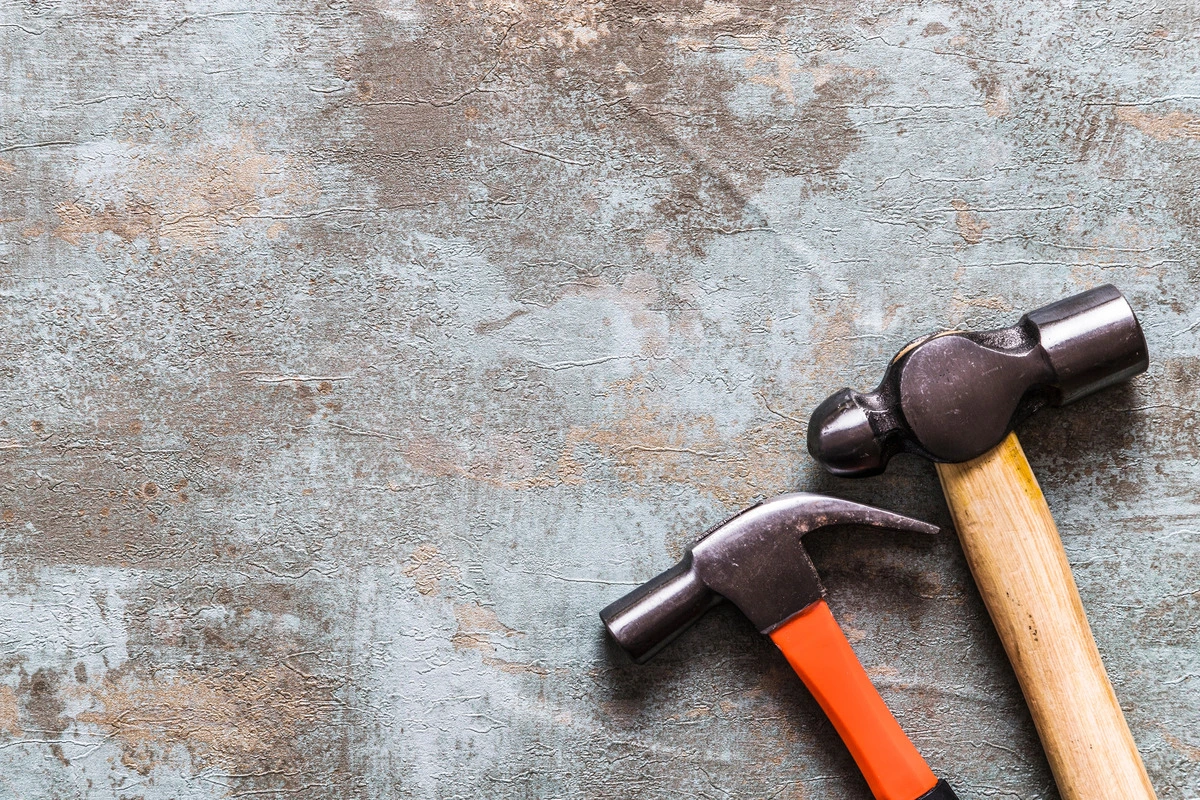
high-angle-view-two-hammers-old-wooden-desk

Think all hammers do the same job? You swing, you hit, and something moves or breaks. Simple enough, right? Well, not quite.

There’s an entire world of hammers, each built for a surprisingly specific purpose. You’ve probably heard of the claw hammer or the ball peen, but what about a planishing hammer or a magnetic tack hammer? Yeah, those are real, and they each earn their keep in the workshop.

Let’s meet these unsung heroes of the toolbox and find out what makes them so unique.

1. Bricklayer’s Hammer

Imagine a hammer that moonlights as a chisel - that’s the bricklayer’s hammer. One side features the familiar flat face for striking, while the other side is a sharp chisel edge that can slice through bricks or chip off mortar. It’s basically a two-in-one tool: part hammer, part demolition artist. Masons use it to shape bricks with surprising precision.

If you’ve ever seen someone neatly trim a brick with one swing, now you know their secret.

picture of brick hammer which is similar to rock hammer but bigger with one flat square on one side while having a drawn head into a sharp chisel peen on the other side

2. Cross Peen Hammer

This one’s easy to recognize. Instead of two flat sides, it has a narrow wedge that runs crosswise to the handle. The cross peen hammer is a favorite among blacksmiths and metalworkers because it’s perfect for spreading and shaping hot metal without flattening it all at once.

Think of it as the hammer equivalent of using your fingertips instead of your palm,  providing more control and finesse.

picture of cross peen hammer with regular flat face on one side and flat wedged shaped peen on the other side

3. Geologist’s Hammer

Also known as a rock pick, this hammer is for people who literally break rocks for a living (and fun, apparently). One side has a flat face for striking, and the other ends in a sharp pick designed to pry open seams in stone. Geologists use it to uncover what’s beneath the surface.

If Indiana Jones had majored in geology, this would’ve been his weapon of choice.

4. Blacksmith’s Hammer

This hammer looks heavy because it is. The blacksmith’s hammer features a large, squared face on one side and a slightly tapered or rounded one on the other. It’s made for shaping red-hot metal over an anvil, where balance is everything - heavy enough to move the metal, but precise enough not to distort it. Every ring of this hammer sounds like progress.

5. Upholstery Hammer

Small, light, and surprisingly elegant, the upholstery hammer is for fabric, not force. It has a slim head, often magnetized on one end, which makes it ideal for tacking fabric onto furniture without ruining the finish. One tap drives the tack, another secures it.

Think of it as the polite cousin in the hammer family.

6. Planishing Hammer

This one is all about refinement. The planishing hammer is used in metal shaping to smooth surfaces and remove hammer marks. It has two slightly domed faces, and it’s often used alongside a metal stake or form.

Think of it like the hammer that comes after the chaos, that makes everything neat and shiny again. Car body shops and metal artists both swear by it.

picture of planishing hammer with cylindrical, convex head on both sides

7. Rock Pick

Closely related to the geologist’s hammer, the rock pick has a sharper, thinner point that can crack through tough material. It’s perfect for excavators, fossil hunters, or anyone who likes to find secrets buried in stone.

If a regular hammer hits like a drum, this one hits like a scalpel.

picture of rock hammer with flat head on the one side and a drawn out chisel at the other end

8. Chasing Hammer

Now we’re entering the artistic side of hammer work. Jewelers use the chasing hammer for detailed metalwork. It has a large, rounded face and a slender neck, which allows for delicate, light taps and precise shaping. Its balance gives perfect control over each strike, essential when working with gold or silver.

This hammer isn’t about smashing; it’s about sculpting.

picture of chasing hammer with a head that has a flat circular planishing surface on one side and a round ball peen head on the other side

9. Gavel

This is the only hammer that commands a room instead of a nail. The gavel is the tool of judges, auctioneers, and anyone who enjoys a dramatic “Order!” moment.

It’s made entirely of wood, and its main purpose is to grab attention without breaking anything. When used right, this hammer settles arguments faster than a claw hammer ever could.

10. Welding Hammer

Welders have their own special hammer for cleaning up their work. The welding hammer, or chipping hammer, usually has a spring handle to absorb shock and a pointed or chisel-shaped head to chip away slag and spatter from welds.

It’s the cleanup crew of the welding world.

picture of welding/chipping hammer with a wooden handle and a head that consists of sharp conical nose on one side and a dual bevel chisel on the other side

11. Drywall Hammer

A drywall hammer looks odd at first. One side has a small, hatchet-like blade for scoring or cutting drywall, and the other side has a rounded face for driving nails without damaging the surface. It’s lightweight and perfectly balanced for overhead work. The blade even doubles as a nail puller.

It’s basically a Swiss Army hammer for drywallers.

picture of drywall hammer with a head that is shaped like a hatched on one side and a circular milled face on the other side

12. Magnetic Tack Hammer

If you’ve ever tried holding tiny nails between your fingers and not hitting yourself, this tool feels like magic. The magnetic tack hammer has a small magnetized face that holds nails or tacks in place while you start your strike. Furniture makers, leatherworkers, and hobbyists love it.

It’s the proof that even the smallest hammer can make a big difference.

picture of tack hammer with the design that has one small flat head and a small claw on the other side

13. Climbing Hammer

The climbing hammer looks like a mini pickaxe built for the vertical world. It has a short, sturdy handle and a compact head - one side flat for driving pitons, the other pointed or shaped like an adze for prying and cleaning cracks. Many include a clip hole so climbers can secure it to their harness. Climbers use it to place or remove protection like pitons and bolts on rock faces. The hammer delivers solid, precise strikes, while the pick end handles cleanup or tests if a placement is secure.

Regular hammers simply don’t cut it on a cliff while the climbing hammer balances power, control, and portability to keep climbers safe while shaping their route.

Wrapping It Up

And there you have it: thirteen hammers that prove not all tools are created equal. Each one was born from a specific need, designed by someone solving a very specific problem. Some shape metal, others protect fabric, and a few even preside over courtrooms. The variety is a reminder that every trade has its quirks, and every job deserves the right tool.

Next time someone says, “It’s just a hammer,” you’ll know better. In the world of hammers, there’s always more to hit than meets the eye.